
What Causes Peri-Implantitis Around Dental Implants in Fort Myers?
Peri-implantitis is an inflammatory condition that affects the tissues around dental implants. It begins with bacterial plaque, which triggers gum inflammation. In susceptible patients, that inflammation leads to progressive bone loss around implants and gradually weakens the support an implant depends on.
Poor plaque control and a history of periodontal disease can increase the risk. So can inconsistent maintenance visits, smoking, and certain medical factors, such as poorly controlled diabetes. Early inflammation often develops without noticeable pain, so many patients don’t realize anything is wrong. That’s why regular checks of implant health matter for anyone with dental implants in Fort Myers.
What Is Peri-Implantitis and How Does It Affect Dental Implants?
The American Academy of Periodontology recognizes two main inflammatory diseases around implants: peri-implant mucositis and peri-implantitis. In its classification of periodontal and peri-implant diseases, the AAP describes peri-implantitis as a plaque-associated condition marked by inflammation of the soft tissue around an implant and progressive loss of the bone that supports it.
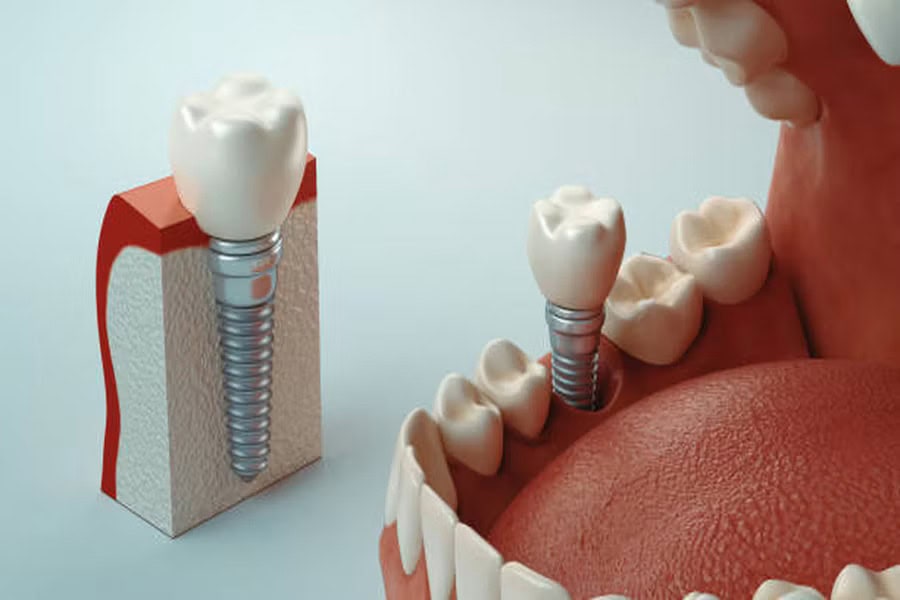
An implant has three main parts. The implant fixture is a post anchored in the jawbone, and an abutment connects it to the crown, bridge, or denture above the gums. Each component is explained in more detail in this overview of the parts of a dental implant. Peri-implantitis affects the gum tissue and bone surrounding the fixture, which is why the condition is relevant to anyone with dental implants in Fort Myers.
What Happens to the Gums and Bone Around an Implant With Peri-Implantitis?
The gum-like tissue around an implant is called the peri-implant mucosa. It forms a soft-tissue seal around the implant, much like gums around a natural tooth. Peri-implantitis usually develops in stages:
- Bacterial plaque builds up on the implant restoration and near the gumline.
- The surrounding peri-implant tissue becomes inflamed.
- In susceptible cases, the inflammatory response is associated with bone resorption, the gradual breakdown of supporting bone.
- Reduced bone support leaves the implant with less foundation for chewing forces.
- Advanced disease can threaten whether the implant stays in place.
Not every case progresses this far, and catching inflammation early gives the dental team more options.
What Is the Difference Between Peri-Implant Mucositis and Peri-Implantitis?
| Characteristic | Peri-implant mucositis | Peri-implantitis |
| Main tissue involved | Soft tissue around the implant | Soft tissue and supporting bone |
| Inflammation | Yes | Yes |
| Progressive supporting bone loss | No | Yes |
| Bleeding on probing | Common | Common |
| Treatment focus | Control inflammation and plaque | Control disease and assess bone damage |
| Clinical importance | May resolve with appropriate care | Requires professional management of a more complex condition |
Peri-implant mucositis can often resolve once plaque and inflammation are controlled. Peri-implantitis involves bone loss that has already occurred, which makes management more involved.
Redness alone doesn’t prove peri-implantitis. Telling the two apart requires a clinical exam and, usually, X-rays.
Is Peri-Implantitis the Same as Gum Disease Around Natural Teeth?
Peri-implantitis and periodontitis (gum disease around natural teeth) share several traits. Both are plaque-associated, both can cause redness and bleeding, both can damage supporting bone, and both depend on good hygiene and professional care.
They also differ in important ways:
- Natural teeth attach to bone through the periodontal ligament, which implants don’t have.
- Implant soft tissue has a different structure and blood supply than gums around a tooth.
- Monitoring and treatment techniques for implants differ from those for natural teeth.
- Restoration components, such as abutments and crown contours, can affect cleaning access.
What Causes Inflammation and Bone Loss Around Dental Implants?
Bacterial plaque is the central cause of peri-implantitis. Other factors don’t cause the disease on their own, but they can make it more likely to develop or progress.
How Does Plaque and Bacterial Biofilm Build Up Around an Implant?
Dental plaque is a sticky bacterial biofilm. It forms on implant crowns, abutments, and near the gumline, collecting most easily in spots that are hard to clean. The bacteria trigger an inflammatory response, and when plaque isn’t removed consistently, that inflammation can become persistent.
An implant crown can’t get a cavity the way natural enamel can. The tissues around it, however, can still develop inflammatory disease.
Why Does Previous Gum Disease Increase the Risk of Peri-Implantitis?
Patients with a history of periodontitis may be more susceptible to peri-implant disease. If a tooth was lost to gum disease, that history should shape how the implant is monitored. Not everyone with previous gum disease develops peri-implantitis, but it’s a risk factor the dental team accounts for, often with a closer maintenance plan. Mitchell Dentistry provides periodontal evaluation and non-surgical gum care for patients who need it.
Can Poorly Designed Implant Crowns Make Cleaning More Difficult?
Yes. In their joint consensus on preventing and managing peri-implant diseases, the Academy of Osseointegration and the AAP noted that prosthetic design, implant positioning, and gum tissue type influence long-term implant health, and that restoration emergence angles can carry significant risk.
Design features that can make cleaning harder include:
- Bulky or overcontoured crowns
- Deep or inaccessible margins
- Excess cement
- Emergence profiles
Not every case of irritation around an implant crown is peri-implantitis, but a restoration that’s hard to clean is worth evaluating.
Can Smoking or Nicotine Contribute to Implant Complications?
Smoking is associated with a higher risk of implant-related complications. Tobacco and nicotine can affect tissue healing and the body’s inflammatory response. Tell your dental team about any tobacco or nicotine use, including vaping, so your risk can be assessed individually. Quitting may lower risk, but it doesn’t remove the need for regular monitoring.
How Can Diabetes and Medical Health Affect Peri-Implant Tissues?
Diabetes, particularly when poorly controlled, can influence healing and inflammatory responses in the tissues around an implant. A diabetes diagnosis doesn’t mean an implant will fail. It does mean a complete medical history matters, and some patients benefit from coordination between their dentist and physician.
Does Teeth Grinding Cause Peri-Implantitis?
Grinding (bruxism) and clenching are mechanical problems, while peri-implantitis is a plaque-associated inflammatory disease. Grinding hasn’t been shown to directly cause peri-implantitis. Heavy forces can, however, contribute to:
- Loosening of the abutment or prosthetic screw
- Chipped or damaged crowns
- Wear on implant dentures and their attachments
The dental team evaluates both biological complications (inflammation and bone loss) and mechanical ones (forces and components). Patients who grind may benefit from a custom nightguard to protect their implant work.
What Are the Early Warning Signs of Peri-Implantitis?
Early symptoms can be mild or absent, and many overlap with other conditions. Treat the signs below as reasons to have an implant checked, not as a self-diagnosis.
Why Do Gums Bleed Around a Dental Implant?
Bleeding often signals inflammation. You may notice it while brushing or cleaning between teeth, or a clinician may find it during gentle probing. Bleeding alone can’t distinguish mucositis from peri-implantitis. If it persists or recurs, schedule an evaluation.
Can Peri-Implantitis Cause Red, Swollen, or Tender Gums?
Yes. Possible soft-tissue symptoms include:
- Redness
- Swelling
- Tenderness
- Changes in gum contour
- Bleeding
- Recurring irritation
Symptoms vary, and some cases are much less noticeable than others.
Can Bone Loss Around an Implant Occur Without Pain?
Yes. Progressive inflammation and bone loss often cause little or no pain early on. That’s a key reason maintenance appointments matter: comparing current X-rays with earlier ones can reveal bone changes you can’t feel or see.
What Does Gum Recession Around an Implant Mean?
Recession means the gum tissue has pulled back, exposing part of the crown, abutment, or occasionally the implant surface. It can happen for several reasons, including thin tissue, implant position, or inflammation. Recession alone doesn’t prove peri-implantitis. The dentist evaluates bone levels, inflammation, tissue thickness, and restoration design to find the cause.
Is a Loose Implant Crown the Same as a Loose Implant Fixture?
No. Several different parts can feel loose:
- Loose crown: The crown has come loose from the abutment.
- Loose abutment: The connector between fixture and crown has shifted.
- Loose prosthetic screw: The screw holding the restoration has backed out.
- Moving implant fixture: The post in the bone itself moves.
Loose crowns, abutments, and screws are usually mechanical problems that can often be repaired. Movement of the fixture may signal significant loss of bone support and needs prompt assessment. Either way, don’t try to tighten or adjust anything yourself.
When Should You Contact an Implant Dentist in Fort Myers?
Contact your dental office if you notice any of these around an implant:
- Persistent bleeding
- Recurring swelling
- Drainage or pus
- A bad taste around the implant
- Increasing discomfort
- Movement of the implant or restoration
- Receding gums
- Difficulty cleaning the restoration
- Changes in your bite or prosthesis fit
Fever, significant facial swelling, or feeling generally unwell need urgent professional assessment. Mitchell Dentistry offers same-day emergency dentistry in Fort Myers when the schedule allows. If swelling affects your breathing, swallowing, or the area around your eye, seek emergency medical care right away.
How Does Peri-Implantitis Damage the Bone Supporting an Implant?
Bone loss is what separates peri-implantitis from simple gum inflammation, and it’s what puts the implant itself at risk.
Why Is Supporting Jawbone Important for Implant Stability?
An implant fixture is anchored through osseointegration, the process in which bone bonds to the implant surface during healing. This overview of how implants heal in the jawbone covers that process in more detail. The bone-to-implant connection lets the implant withstand chewing forces. When peri-implantitis causes progressive bone loss, the foundation shrinks and the implant becomes less able to handle everyday function.
Is Normal Bone Remodeling the Same as Peri-Implant Bone Loss?
No. Some change in bone level is expected as bone heals and adapts after an implant is placed and restored. Inflammation-related bone loss is different: it continues over time instead of stabilizing.
Baseline X-rays taken after the implant is restored give the dentist a reference point, so later images can show whether bone levels are stable or declining. What counts as a concerning change depends on the implant, the timing, and the clinical findings together, so it isn’t something patients can interpret from a single number.
Can Peri-Implantitis Eventually Cause Dental Implant Failure?
It can. Advanced disease can undermine implant support to the point of implant loss. However:
- Not every inflamed implant fails.
- Earlier intervention generally means more management options.
- The outlook depends on the extent of disease, the shape of the bone defect, the restoration, and patient factors.
How Do Dentists Diagnose Peri-Implantitis in Fort Myers?
Diagnosis combines what the patient reports, what the dentist observes, and what X-rays show. No single finding is enough on its own.
What Does an Implant Health Examination Include?
An implant health exam may include a review of:
- Your symptoms and when they started
- Your medical and dental history
- When and where the implant was placed
- Your cleaning routine and tools
- The gums around the implant
- Plaque deposits on the restoration
- The design of the crown, bridge, or denture
- Gentle probing around the implant
- Bleeding or suppuration (pus) on probing
- Implant mobility
- Your bite
Why Do Dentists Measure Gum Pockets Around Dental Implants?
Peri-implant probing measures the space between the gum tissue and the implant. Like periodontal charting for natural teeth, the readings are most useful compared with previous records. The dentist looks at bleeding on probing, changes in pocket depth, and changes in the gum margin together. A single pocket-depth number doesn’t diagnose peri-implantitis.
How Do Dental X-Rays Help Detect Bone Loss Around an Implant?
Dental X-rays, often periapical images, help evaluate the bone supporting an implant. Comparing them with earlier images shows whether bone loss is progressing, and findings are interpreted alongside the clinical exam.
Mitchell Dentistry has CBCT (3D cone beam) imaging available when it’s clinically appropriate. CBCT may be considered for selected complex situations, but it isn’t automatically required to evaluate an inflamed implant.
Why Are Baseline Implant Records Important?
Baseline records make change easier to spot. Useful records include:
- X-rays showing initial bone levels after restoration
- Previous probing measurements
- The implant system and restoration details
If another dentist placed your implant, bring any available records or ask that office to send them.
Can Peri-Implantitis Be Treated Without Removing the Implant?
Often, yes, depending on how far the disease has progressed. The AO/AAP consensus describes a stepwise approach that starts with non-surgical management and moves to surgical options when needed.
How Is Peri-Implant Mucositis Usually Managed?
Management focuses on controlling inflammation and usually includes:
- A professional assessment of the implant and tissue
- Appropriate professional cleaning around the implant
- A review of home-care technique and tools
- An evaluation of cleaning access around the restoration
- Improved daily plaque control
- Reassessment to confirm the inflammation has resolved
Rinses alone aren’t a substitute for professional care and effective plaque removal.
What Treatment May Be Needed for Peri-Implantitis?
Management depends on disease severity and bone condition. It may involve:
- Assessing how much bone support has been lost
- Mechanical biofilm removal with instruments suitable for implant surfaces
- Reviewing restoration contours to improve cleaning access
- Treating periodontal disease around natural teeth
- Reassessing the tissues after initial treatment
- Specialist referral
- Surgical management when indicated
Mitchell Dentistry’s periodontal care focuses on non-surgical therapy. When an implant needs surgical treatment, the team can explain your findings and coordinate referral to an appropriate specialist.
Can Lost Bone Around an Implant Be Rebuilt?
Sometimes. Selected bone defects may be considered for regenerative treatment, but results depend on the defect’s shape, whether the disease is controlled, the implant surface, and tissue conditions. Not all lost bone can be regenerated. This article on bone grafting before implants explains how bone is rebuilt for implants more generally.
When Might an Implant Need to Be Removed?
Removal may be recommended when:
- Bone loss is advanced
- Infection can’t be controlled
- The implant has lost stability
- The long-term outlook is unfavorable
- Other serious complications are present
Removal isn’t the inevitable outcome of peri-implantitis.
Can a Patient Receive Another Implant After Implant Loss?
Replacement may be possible, but it’s not guaranteed. The site needs to heal, and the dentist must evaluate the remaining bone, the gum tissue, and what contributed to the original problem. Some sites need bone grafting first. An overview of dental implant candidacy explains how candidacy is evaluated, and this guide to the factors affecting implant treatment cost explains how added steps, such as grafting, can change a treatment plan.
How Can Patients Prevent Peri-Implantitis?
Prevention comes down to thorough daily plaque removal and consistent professional monitoring.
How Should You Clean Around an Implant Crown?
- Brush the crown and the gumline around it twice a day.
- Clean between the implant crown and neighboring teeth daily.
- Use the tools your hygienist recommends, such as floss, interdental brushes, or a water flosser.
- Don’t skip the implant because it can’t decay.
- Ask for a demonstration if an area is hard to reach.
How Should Implant Bridges and Implant Dentures Be Cleaned?
Cleaning depends on the restoration type:
- Implant bridges: Clean beneath the connected teeth with floss threaders or interdental brushes.
- Removable implant dentures: Take the denture out to clean it, and clean the attachments and gum tissue underneath.
- Fixed full-arch prostheses: Follow professional guidance, since these restorations have areas that need specialized tools.
No single method works for every implant design, so ask your hygienist which techniques fit yours.
Why Are Regular Implant Maintenance Appointments Necessary?
Maintenance visits can catch problems you can’t see or feel, including:
- Inflammation
- Plaque buildup
- Changes in bone support
- Gum recession
- Loose components
- Cleaning-access problems
- Bite changes
There’s no universal interval. Recall frequency should follow your periodontal history, restoration type, home care, and overall risk. Implant checks can be part of your routine dental exams and cleanings.
Can Treating Natural-Tooth Gum Disease Help Protect Implants?
Yes. Periodontal disease around natural teeth should be controlled as part of whole-mouth health. If you have signs of gum disease, treatment for gum disease around your natural teeth supports the health of your implants too.
What Should Patients Do if Cleaning Around an Implant Is Difficult?
Mention it at your next visit or call sooner. The dental team can evaluate whether the restoration limits access, recommend suitable tools, and discuss whether the crown or prosthesis contour should be reviewed. Don’t attempt to modify any implant component at home.
Do Single Implants, Implant Bridges, and Dentures Have Different Maintenance Needs?
Yes. Each restoration type has its own cleaning challenges.
Single-Tooth Implant Crowns
Focus on the gumline and the contacts with neighboring teeth, where plaque is most often missed.
Implant-Supported Bridges
The space beneath connected replacement teeth traps plaque easily and needs daily cleaning. This guide to the implant-supported bridge explains how these restorations are designed and maintained.
Implant-Retained and Snap-On Dentures
Implant dentures need daily cleaning of the denture, attachments, and abutments. Attachments wear over time, so they and the tissue beneath should be checked professionally.
Fixed Full-Arch Implant Restorations
Fixed full-arch restorations, such as All-on-4 dental implants, have more surfaces that hold plaque. They need careful cleaning underneath and regular professional maintenance.
What Questions Should You Ask About Implant Health During a Dental Visit?
- Are my gums around the implant healthy?
- Is there bleeding or inflammation?
- Have my bone levels changed since my previous X-rays?
- Is my implant crown easy to clean?
- Do I need different cleaning tools?
- Is my implant abutment or screw stable?
- Does my bite put excessive pressure on the restoration?
- How often should my implants be monitored?
- Does my gum-disease history change my risk?
- Is a specialist evaluation appropriate?
Schedule an Implant Health Evaluation in Fort Myers, FL
If you’ve noticed bleeding, swelling, or changes around an existing dental implant, Mitchell Dentistry in Fort Myers can evaluate your oral health and explain the appropriate next steps, including specialist care when needed.
Your implant doesn’t need to have been placed here. Patients with implants from other offices are welcome to bring their records and questions about gum irritation, cleaning difficulties, or changes in their restoration. Mitchell Dentistry serves patients throughout Fort Myers, Lee County, and nearby Sanibel Island. If you have questions about an existing implant, you can schedule a consultation to have it evaluated.
Frequently Asked Questions About Peri-Implantitis
Can dental implants get infected?
The tissues around implants can develop plaque-associated inflammatory disease, often called an implant infection. A dentist needs to examine the implant to determine the cause.
Is peri-implantitis the same as peri-implant mucositis?
No. Mucositis is soft-tissue inflammation without progressive bone loss. Peri-implantitis includes bone loss.
Can peri-implantitis occur years after implant placement?
Yes. Peri-implant disease can develop after an implant has functioned well for years.
Is bleeding around an implant normal?
Persistent or recurring bleeding warrants a professional evaluation.
Can peri-implantitis develop without pain?
Yes. Pain isn’t required for the condition to be present.
Can peri-implantitis cause implant failure?
Advanced disease can compromise implant support, but outcomes vary.
Can you reverse peri-implantitis?
Inflammation can often be controlled, but lost bone doesn’t automatically return. Treatment depends on the clinical findings.
Does smoking increase the risk of peri-implantitis?
Smoking is a relevant risk factor and should be discussed during implant evaluations.
Can an implant crown trap bacteria?
A restoration that’s hard to clean can contribute to plaque buildup.
How do dentists check bone loss around an implant?
They combine a clinical exam, probing measurements, and appropriate X-rays, compared with previous records.
How often should dental implants be professionally cleaned?
It depends on your periodontal risk, restoration design, hygiene, and implant history.